

Technology
Learn about the platform powering today's most advanced automation applications
Learn more about MujinOS
Learn about the platform powering today's most advanced automation applications
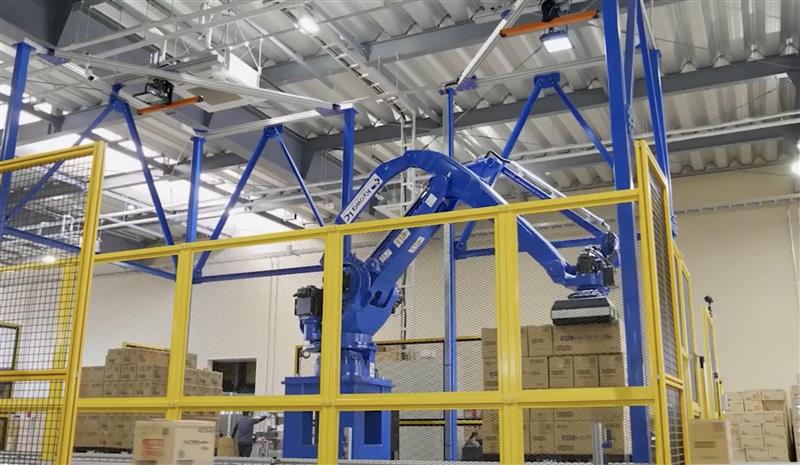
Confronting the 10% Problem: What to Do About the Intelligence Gap in Traditional Robotics
Confronting the 10% Problem: What to Do About the Intelligence Gap in Traditional Robotics
Walk through almost any modern DC and the progress is undeniable: conveyors, AGVs, and automated storage systems are handling the heavy lifting with mechanical precision. Yet, near the outbound dock or the receiving bay, you will almost always find a manual process.
Operations leaders often refer to this as the "10% Problem." It represents the final slice of warehouse activity—variable inputs, unpredictable sequencing, and edge cases—that has resisted every automation wave. While 90% of tasks are easily automated, this last 10% has traditionally required human judgment to manage.
In today’s market, customers need an intelligence layer to help close the gap.
The ROI Bottleneck: Why the 10% Stayed Manual
Traditional industrial robots are powerful, but they are inherently rigid. They excel at repetitive tasks where nothing changes, but they struggle with the "exceptions" that define the 10% problem: oddly shaped items, packing errors, or system mismatches.
The bottleneck hasn't been hardware; robots have had the necessary reach and payload for years. Conventional automation lacks the flexibility to deal with:
Exception Handling: Managing items that don’t fit standard dimensions or packaging.
System Incompatibility: Bridging the gap when data silos or legacy systems fail to communicate perfectly.
Demand Spikes: Adapting when order profiles change or volume increases unexpectedly.
The gap in the industry isn’t the hardware; it’s the intelligence. To solve the 10% problem, you need a system that can perceive what is in front of it and reason about the next move in real time, without requiring a programmer for every adjustment.
How MujinOS Closes the Gap
MujinOS provides the intelligence layer that manages the variability that previously kept the "10%" manual. By perceiving and adapting in real time, it allows robots to handle the complexity of a modern DC.
Tech-less Operation: MujinOS requires no prior SKU registration. When a new case type or an "exception" arrives, the vision system identifies it and determines the optimal grasp automatically.
Real Time Stacking: Instead of using fixed templates, the system calculates optimal arrangements on the fly. This allows the robot to handle mixed-SKU pallets and maintain stability regardless of the product mix.
Vision Driven Verification: Mujin’s integrated vision monitors every placement in real time. It confirms positions and builds a dynamic model of the workspace to ensure the system is operating against reality, not a static assumption.
Proven Results in Complex Operations
At Trusco Nakayama’s advanced logistics facility in Japan’s Saitama Prefecture, transport and storage were already automated, but outbound palletizing remained manual due to variable box heights and unpredictable sequencing. After deploying MujinOS-powered solutions, the facility now handles twice the order volume with the same workforce.
Similarly, Mujin stepped in at Kyowa Shiko, a distributor located in Shikokuchuo-shi, Ehime, Japan. Being away from major metropolitan hubs, the introduction of depalletizers controlled by MujinOS eliminated the company’s dependency on hard-to-find labor. Shipping capacity increased by 70%, overtime was virtually eliminated, and operations managers gained a predictable, reliable baseline for their daily work plans.
The Bottom Line
The 10% problem finally has a solution. For any facility that has already automated its straightforward processes, it is time to look at where manual tasks remain and why.
If those tasks involve mixed products and changing conditions, they no longer require a human workaround. MujinOS was built specifically to handle the variability and exceptions that define modern logistics. The gap is closing, and the full potential of your warehouse is finally within reach.
Walk through almost any modern DC and the progress is undeniable: conveyors, AGVs, and automated storage systems are handling the heavy lifting with mechanical precision. Yet, near the outbound dock or the receiving bay, you will almost always find a manual process.
Operations leaders often refer to this as the "10% Problem." It represents the final slice of warehouse activity—variable inputs, unpredictable sequencing, and edge cases—that has resisted every automation wave. While 90% of tasks are easily automated, this last 10% has traditionally required human judgment to manage.
In today’s market, customers need an intelligence layer to help close the gap.
The ROI Bottleneck: Why the 10% Stayed Manual
Traditional industrial robots are powerful, but they are inherently rigid. They excel at repetitive tasks where nothing changes, but they struggle with the "exceptions" that define the 10% problem: oddly shaped items, packing errors, or system mismatches.
The bottleneck hasn't been hardware; robots have had the necessary reach and payload for years. Conventional automation lacks the flexibility to deal with:
Exception Handling: Managing items that don’t fit standard dimensions or packaging.
System Incompatibility: Bridging the gap when data silos or legacy systems fail to communicate perfectly.
Demand Spikes: Adapting when order profiles change or volume increases unexpectedly.
The gap in the industry isn’t the hardware; it’s the intelligence. To solve the 10% problem, you need a system that can perceive what is in front of it and reason about the next move in real time, without requiring a programmer for every adjustment.
How MujinOS Closes the Gap
MujinOS provides the intelligence layer that manages the variability that previously kept the "10%" manual. By perceiving and adapting in real time, it allows robots to handle the complexity of a modern DC.
Tech-less Operation: MujinOS requires no prior SKU registration. When a new case type or an "exception" arrives, the vision system identifies it and determines the optimal grasp automatically.
Real Time Stacking: Instead of using fixed templates, the system calculates optimal arrangements on the fly. This allows the robot to handle mixed-SKU pallets and maintain stability regardless of the product mix.
Vision Driven Verification: Mujin’s integrated vision monitors every placement in real time. It confirms positions and builds a dynamic model of the workspace to ensure the system is operating against reality, not a static assumption.
Proven Results in Complex Operations
At Trusco Nakayama’s advanced logistics facility in Japan’s Saitama Prefecture, transport and storage were already automated, but outbound palletizing remained manual due to variable box heights and unpredictable sequencing. After deploying MujinOS-powered solutions, the facility now handles twice the order volume with the same workforce.
Similarly, Mujin stepped in at Kyowa Shiko, a distributor located in Shikokuchuo-shi, Ehime, Japan. Being away from major metropolitan hubs, the introduction of depalletizers controlled by MujinOS eliminated the company’s dependency on hard-to-find labor. Shipping capacity increased by 70%, overtime was virtually eliminated, and operations managers gained a predictable, reliable baseline for their daily work plans.
The Bottom Line
The 10% problem finally has a solution. For any facility that has already automated its straightforward processes, it is time to look at where manual tasks remain and why.
If those tasks involve mixed products and changing conditions, they no longer require a human workaround. MujinOS was built specifically to handle the variability and exceptions that define modern logistics. The gap is closing, and the full potential of your warehouse is finally within reach.
Hubspot
Set a portal ID and form in the Properties.
Have a question?
Learn how MujinOS delivers real-time perception, motion control, and no-code deployment—across any robotic system
Have a question?
Learn how MujinOS delivers real-time perception, motion control, and no-code deployment—across any robotic system