

Technology
Learn about the platform powering today's most advanced automation applications
Learn more about MujinOS
Learn about the platform powering today's most advanced automation applications
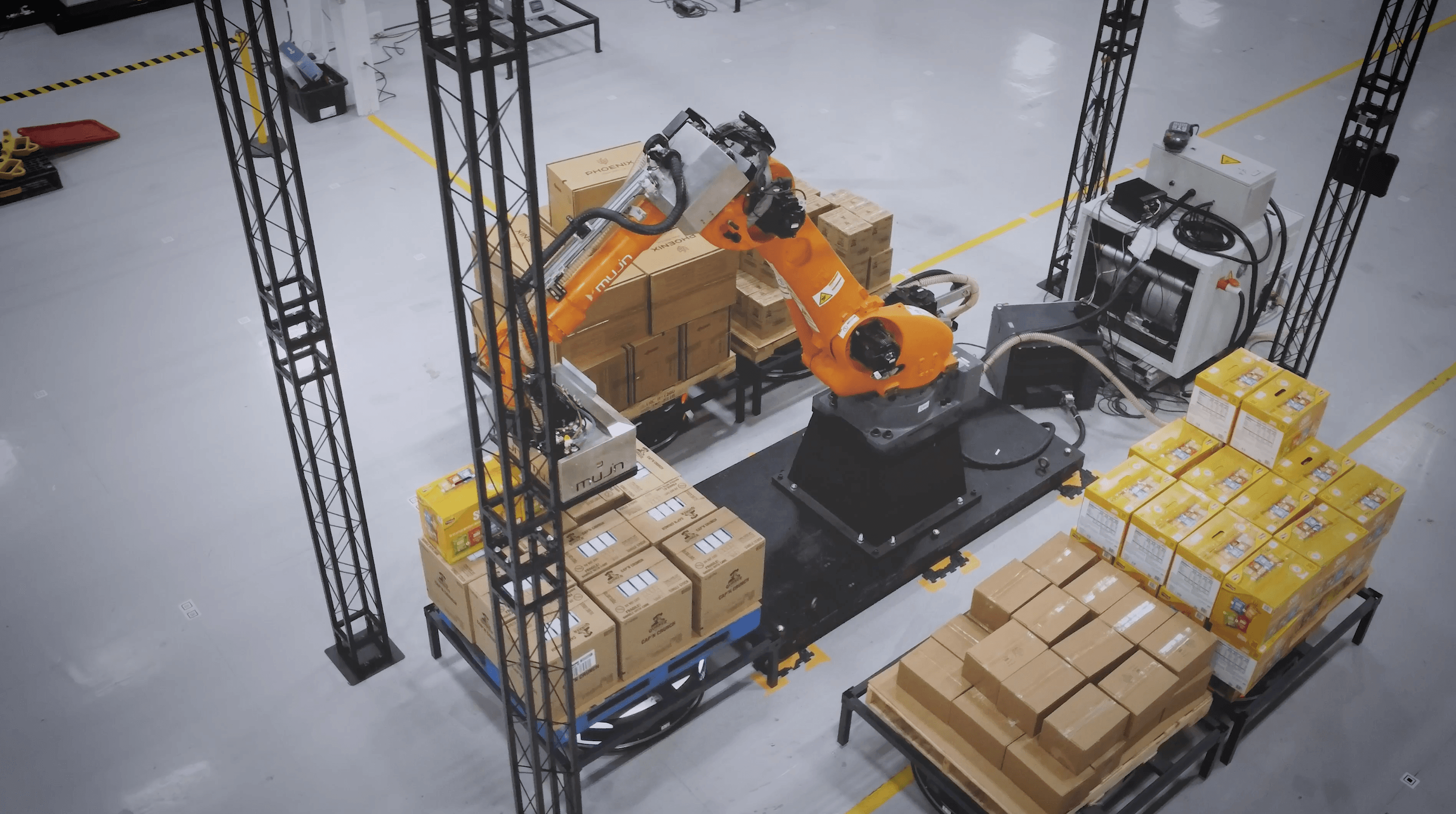
Mixed SKU Palletizing: The Hidden Driver of Margin Erosion
Mixed SKU Palletizing: The Hidden Driver of Margin Erosion
Executive Summary
Margin erosion is one of the most pressing challenges facing logistics operators, manufacturers, and retailers today. While rising labor costs and fluctuating demand are widely acknowledged, a less visible, but equally critical driver is the inefficiency embedded in mixed SKU palletizing operations. As supply chains shift toward high mix, demand driven fulfillment, traditional palletizing approaches are no longer sufficient. Manual processes and rigid automation systems introduce inefficiencies that compound across labor, transportation and throughput, ultimately eroding margins. Addressing this challenge requires a fundamental shift toward intelligent, software defined automation.
Margin Erosion Starts on the Warehouse Floor
The economics of modern supply chains have fundamentally changed. E-commerce growth, SKU proliferation and increasing service expectations have created a more complex fulfillment environment where efficiency directly determines profitability. Global online retail sales are projected to reach nearly $6.9 trillion by 2026, continuing to drive higher order volumes with smaller, more fragmented shipments.
At the same time, labor instability continues to strain operations. Warehouse turnover rates in the United States have reached as high as 49%, meaning nearly half of the workforce must be replaced each year. This level of churn introduces constant disruption, increased training costs and reduced productivity. In fact, warehouses experiencing high turnover can see productivity decline by over 20% while error rates rise significantly.
These macro pressures converge at a critical operational point: palletizing. As organizations move away from single-SKU pallet flows toward mixed, store-ready configurations, palletizing becomes significantly more complex and more impactful on margins.
The Growing Complexity of Mixed SKU Palletizing
Mixed SKU palletizing introduces a level of operational complexity that most traditional systems were not designed to handle. Unlike single SKU palletizing, where uniformity simplifies stacking, mixed palletizing requires continuous decision making around sequencing, weight distribution, product compatibility and stability. Each pallet must be built to meet downstream requirements such as store layouts, delivery routes or merchandising needs.
This complexity is further compounded by packaging variability. Products differ in size, shape, rigidity and fragility, requiring dynamic adjustments during pallet construction. In manual environments, these decisions rely heavily on worker experience, leading to inconsistency and inefficiency. In traditional automation environments, rigid programming limits the ability to adapt to change, resulting in frequent interruptions and reconfiguration.
The result is a process that is inherently difficult to scale, particularly in high volume, high mix operations where speed and accuracy are equally critical.
Where Margins Are Lost
The inefficiencies associated with mixed SKU palletizing manifest across multiple cost centers, creating a cumulative impact on margins.
Labor remains one of the most significant contributors. High turnover rates, often exceeding 40% annually drive continuous recruitment and training costs while reducing operational stability. Replacing a single warehouse worker can cost upwards of $18,000 when accounting for hiring, onboarding and lost productivity. This constant churn not only increases costs but also limits the ability to maintain consistent performance.
Pallet quality is another major source of margin loss. Poorly constructed pallets lead to damaged goods, unstable loads and increased need for manual rework. These issues propagate downstream, affecting transportation efficiency and store operations. Inefficient pallet builds also result in underutilized truck space, increasing the cost per shipment and reducing overall logistics efficiency.
Operational bottlenecks further compound the problem. Mixed SKU palletizing often becomes the slowest step in the fulfillment process, constraining throughput and creating congestion in outbound workflows. As demand increases, these bottlenecks prevent organizations from scaling efficiently, directly limiting revenue potential.
Why Traditional Automation Falls Short
While many organizations have turned to automation to address these challenges, traditional systems often fall short in mixed SKU environments. Fixed palletizers and rule-based software rely on predefined logic, making them inherently rigid. Any change in SKU mix, packaging or order requirements typically requires manual reprogramming or engineering intervention.
This lack of flexibility introduces delays and additional costs, reducing the overall return on investment. Furthermore, traditional systems operate in silos, lacking the ability to coordinate across robots, conveyors and warehouse systems. As a result, they fail to optimize the broader workflow, addressing only isolated tasks rather than the end-to-end process.
In a world where variability is the norm, these limitations make traditional automation a partial solution at best.
A New Approach: MujinOS and Intelligent Automation
To address the challenges of mixed SKU palletizing, a fundamentally different approach is required, one that replaces rigid programming with real-time intelligence. MujinOS delivers this through a unified, software defined platform that integrates perception, motion planning and orchestration into a single operational layer.
At the core of MujinOS is a real-time digital twin, which continuously mirrors the physical environment. This enables simulation and validation of pallet configurations before execution, reducing errors and improving efficiency. Instead of relying on manual pattern design, the system dynamically computes optimal packing strategies based on product characteristics such as size, weight and fragility.
MujinOS also introduces teacherless motion planning, eliminating the need for pre-programmed robot paths. Robots can adapt instantly to changes in SKU mix, enabling seamless transitions between different pallet configurations without downtime. This significantly reduces engineering effort while increasing operational flexibility.
Beyond individual tasks, MujinOS orchestrates the entire workflow, coordinating robots, conveyors, and material handling systems in real time. This ensures that palletizing is not treated as an isolated process, but as an integrated component of a larger, optimized operation.
Transforming Margin Erosion into Margin Expansion
By addressing the root causes of inefficiency in mixed SKU palletizing, MujinOS enables organizations to reclaim lost margin and unlock new operational value. Labor dependency is reduced, allowing operators to stabilize their workforce and redeploy resources to higher value tasks. Throughput increases as bottlenecks are eliminated and processes become more predictable.
Pallet quality improves significantly, reducing product damage and minimizing downstream disruptions. At the same time, optimized packing strategies increase pallet density, improving transportation efficiency and lowering cost per shipment. These gains compound across the supply chain, transforming palletizing from a cost center into a strategic advantage.
Conclusion
Mixed SKU palletizing has emerged as a critical inflection point in modern warehouse operations. As supply chains become more complex, the inefficiencies embedded in traditional processes are no longer sustainable. Margin erosion is not the result of a single issue, but the accumulation of small inefficiencies that compound over time.
By introducing intelligence, adaptability and real-time optimization, MujinOS redefines what is possible in palletizing operations. It enables organizations to move beyond static automation toward a dynamic, software driven model that continuously improves performance.
In doing so, it not only addresses the challenges of today’s high mix environments but also establishes a foundation for scalable, autonomous operations, turning one of the most persistent sources of margin erosion into a powerful driver of margin expansion.
Executive Summary
Margin erosion is one of the most pressing challenges facing logistics operators, manufacturers, and retailers today. While rising labor costs and fluctuating demand are widely acknowledged, a less visible, but equally critical driver is the inefficiency embedded in mixed SKU palletizing operations. As supply chains shift toward high mix, demand driven fulfillment, traditional palletizing approaches are no longer sufficient. Manual processes and rigid automation systems introduce inefficiencies that compound across labor, transportation and throughput, ultimately eroding margins. Addressing this challenge requires a fundamental shift toward intelligent, software defined automation.
Margin Erosion Starts on the Warehouse Floor
The economics of modern supply chains have fundamentally changed. E-commerce growth, SKU proliferation and increasing service expectations have created a more complex fulfillment environment where efficiency directly determines profitability. Global online retail sales are projected to reach nearly $6.9 trillion by 2026, continuing to drive higher order volumes with smaller, more fragmented shipments.
At the same time, labor instability continues to strain operations. Warehouse turnover rates in the United States have reached as high as 49%, meaning nearly half of the workforce must be replaced each year. This level of churn introduces constant disruption, increased training costs and reduced productivity. In fact, warehouses experiencing high turnover can see productivity decline by over 20% while error rates rise significantly.
These macro pressures converge at a critical operational point: palletizing. As organizations move away from single-SKU pallet flows toward mixed, store-ready configurations, palletizing becomes significantly more complex and more impactful on margins.
The Growing Complexity of Mixed SKU Palletizing
Mixed SKU palletizing introduces a level of operational complexity that most traditional systems were not designed to handle. Unlike single SKU palletizing, where uniformity simplifies stacking, mixed palletizing requires continuous decision making around sequencing, weight distribution, product compatibility and stability. Each pallet must be built to meet downstream requirements such as store layouts, delivery routes or merchandising needs.
This complexity is further compounded by packaging variability. Products differ in size, shape, rigidity and fragility, requiring dynamic adjustments during pallet construction. In manual environments, these decisions rely heavily on worker experience, leading to inconsistency and inefficiency. In traditional automation environments, rigid programming limits the ability to adapt to change, resulting in frequent interruptions and reconfiguration.
The result is a process that is inherently difficult to scale, particularly in high volume, high mix operations where speed and accuracy are equally critical.
Where Margins Are Lost
The inefficiencies associated with mixed SKU palletizing manifest across multiple cost centers, creating a cumulative impact on margins.
Labor remains one of the most significant contributors. High turnover rates, often exceeding 40% annually drive continuous recruitment and training costs while reducing operational stability. Replacing a single warehouse worker can cost upwards of $18,000 when accounting for hiring, onboarding and lost productivity. This constant churn not only increases costs but also limits the ability to maintain consistent performance.
Pallet quality is another major source of margin loss. Poorly constructed pallets lead to damaged goods, unstable loads and increased need for manual rework. These issues propagate downstream, affecting transportation efficiency and store operations. Inefficient pallet builds also result in underutilized truck space, increasing the cost per shipment and reducing overall logistics efficiency.
Operational bottlenecks further compound the problem. Mixed SKU palletizing often becomes the slowest step in the fulfillment process, constraining throughput and creating congestion in outbound workflows. As demand increases, these bottlenecks prevent organizations from scaling efficiently, directly limiting revenue potential.
Why Traditional Automation Falls Short
While many organizations have turned to automation to address these challenges, traditional systems often fall short in mixed SKU environments. Fixed palletizers and rule-based software rely on predefined logic, making them inherently rigid. Any change in SKU mix, packaging or order requirements typically requires manual reprogramming or engineering intervention.
This lack of flexibility introduces delays and additional costs, reducing the overall return on investment. Furthermore, traditional systems operate in silos, lacking the ability to coordinate across robots, conveyors and warehouse systems. As a result, they fail to optimize the broader workflow, addressing only isolated tasks rather than the end-to-end process.
In a world where variability is the norm, these limitations make traditional automation a partial solution at best.
A New Approach: MujinOS and Intelligent Automation
To address the challenges of mixed SKU palletizing, a fundamentally different approach is required, one that replaces rigid programming with real-time intelligence. MujinOS delivers this through a unified, software defined platform that integrates perception, motion planning and orchestration into a single operational layer.
At the core of MujinOS is a real-time digital twin, which continuously mirrors the physical environment. This enables simulation and validation of pallet configurations before execution, reducing errors and improving efficiency. Instead of relying on manual pattern design, the system dynamically computes optimal packing strategies based on product characteristics such as size, weight and fragility.
MujinOS also introduces teacherless motion planning, eliminating the need for pre-programmed robot paths. Robots can adapt instantly to changes in SKU mix, enabling seamless transitions between different pallet configurations without downtime. This significantly reduces engineering effort while increasing operational flexibility.
Beyond individual tasks, MujinOS orchestrates the entire workflow, coordinating robots, conveyors, and material handling systems in real time. This ensures that palletizing is not treated as an isolated process, but as an integrated component of a larger, optimized operation.
Transforming Margin Erosion into Margin Expansion
By addressing the root causes of inefficiency in mixed SKU palletizing, MujinOS enables organizations to reclaim lost margin and unlock new operational value. Labor dependency is reduced, allowing operators to stabilize their workforce and redeploy resources to higher value tasks. Throughput increases as bottlenecks are eliminated and processes become more predictable.
Pallet quality improves significantly, reducing product damage and minimizing downstream disruptions. At the same time, optimized packing strategies increase pallet density, improving transportation efficiency and lowering cost per shipment. These gains compound across the supply chain, transforming palletizing from a cost center into a strategic advantage.
Conclusion
Mixed SKU palletizing has emerged as a critical inflection point in modern warehouse operations. As supply chains become more complex, the inefficiencies embedded in traditional processes are no longer sustainable. Margin erosion is not the result of a single issue, but the accumulation of small inefficiencies that compound over time.
By introducing intelligence, adaptability and real-time optimization, MujinOS redefines what is possible in palletizing operations. It enables organizations to move beyond static automation toward a dynamic, software driven model that continuously improves performance.
In doing so, it not only addresses the challenges of today’s high mix environments but also establishes a foundation for scalable, autonomous operations, turning one of the most persistent sources of margin erosion into a powerful driver of margin expansion.
Hubspot
Set a portal ID and form in the Properties.
Have a question?
Learn how MujinOS delivers real-time perception, motion control, and no-code deployment—across any robotic system
Have a question?
Learn how MujinOS delivers real-time perception, motion control, and no-code deployment—across any robotic system