

Technology
Learn about the platform powering today's most advanced automation applications
Learn more about MujinOS
Learn about the platform powering today's most advanced automation applications
Physical AI at Work: How Mujin Redefined Automation Intelligence at MODEX 2026
Physical AI at Work: How Mujin Redefined Automation Intelligence at MODEX 2026
If there was one thing every visitor to the Mujin booth at MODEX 2026 witnessed, it was the tangible reality of physical AI, experiencing robots that perceive their environment, plan their own movements in real time, and execute complex tasks without human intervention or pre-programmed paths.
Four robots. Four different manufacturers. Zero human in the loop. All orchestrated flawlessly by a single intelligent operating system.
For decades, warehouse and logistics operations have been built on integration chaos: rigid systems that don't talk to each other, manufacturers whose products don't play well with competitors, and operations teams stuck maintaining separate control layers for every robot. Each system sees only its own corner of the warehouse. Each movement is pre-taught. Scaling is a monumental challenge.
Mujin came to MODEX 2026 with a different vision: what if robots had intelligence?
From April 13-16 at the Georgia World Congress Center in Atlanta, Mujin showcased how physical AI transforms automation from reactive sequences into intelligent, adaptive systems. The centerpiece: MujinOS, a no-code platform that brings real perception, autonomous motion planning, and dynamic orchestration to any robot or warehouse floor. It's automation that learns, adapts, and optimizes in real time without human intervention or rigid pre-programming.
The message to every integrator, end user, and manufacturer on the floor was clear: this is physical AI in production. And it's changing what's possible.
The Living Proof: Four Robot Systems, One Brain
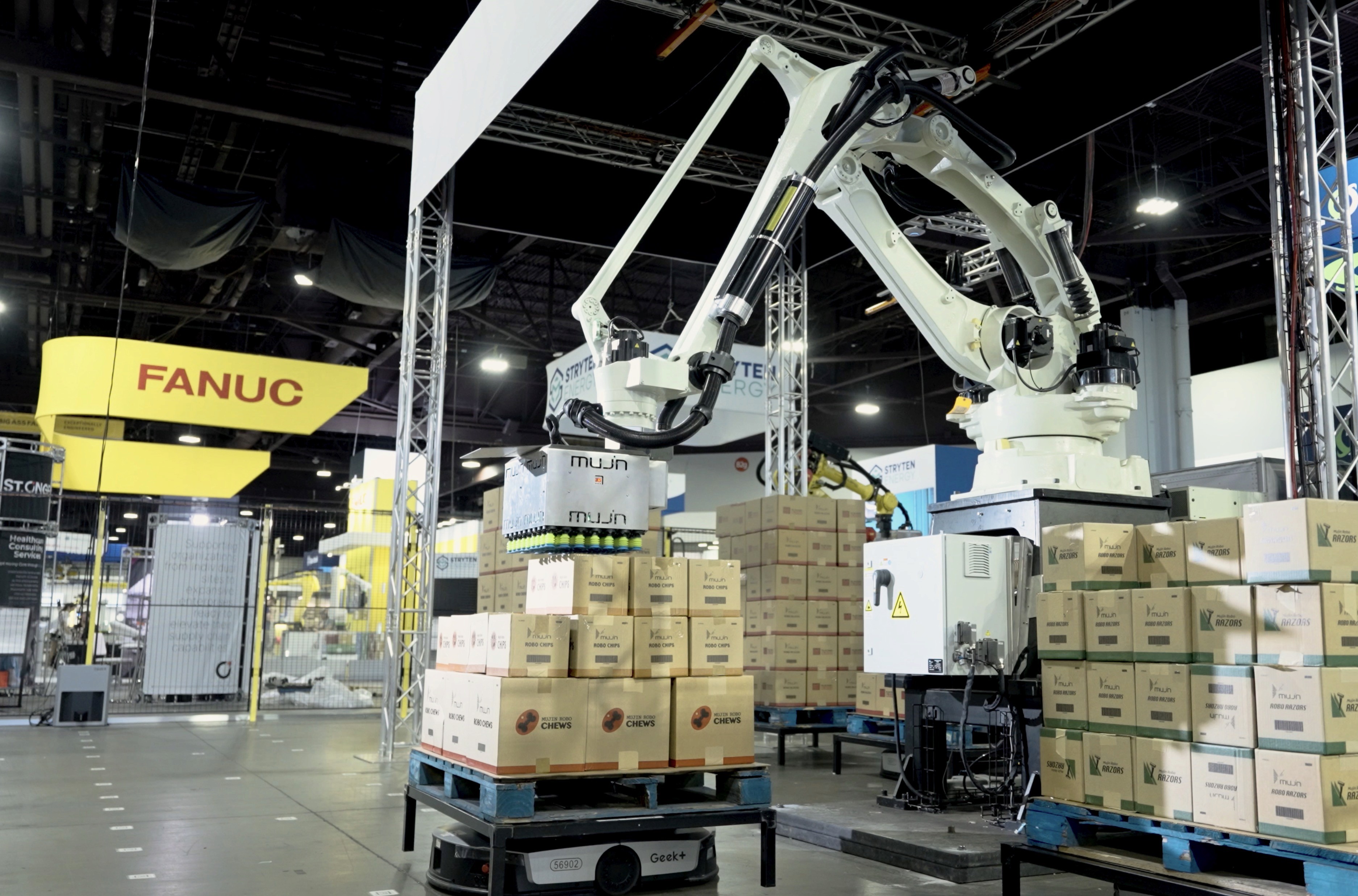
The centerpiece of the Mujin booth wasn't a flashy marketing display. It was a continuous loop of real work: robots from Kawasaki, FANUC, Yaskawa, and Geek+, each assigned to do different tasks, each built by different companies—orchestrated by MujinOS into a seamless, autonomous workflow. No teaching. No intervention. Just pure intelligence coordinating hardware across competing vendors.
This wasn't a simulation running in a digital twin. This was live. This was production-ready.This was the future, running on the floor right now.
Three mission-critical applications demonstrated what intelligent automation actually delivers:
Inbound Palletizing
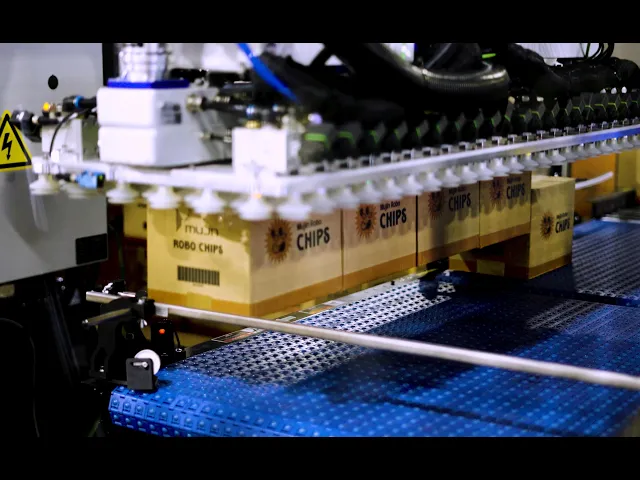
Powered by a Yaskawa robotic arm and Schmalz row picking gripper, with inbound barcode scanning handled by a SICK scan tunnel, this solution achieved rates near 1,000 cases per hour through autonomous motion planning. Unlike traditional robots that follow pre-taught sequences, MujinOS calculates optimized stacking patterns on the fly. Flexible, stable stacking that adapts to variations in case size, pallet position, and load conditions allows for the delivery of maximum pallets per hour with minimal system complexity, eliminating manual intervention entirely.
Mixed-SKU Palletizing (Order Fulfillment)
Set up to create store-ready mixed-SKU pallets, this application handles the complexity and volume that breaks traditional automation. The system manages high SKU variability, changing order profiles, and unpredictable inventory—exactly the scenario where rigid pre-programming fails. MujinOS creates rainbow pallets ready for retail and grocery distribution, perfectly suited for 3PL operations where order profiles and customer requirements shift constantly. Multi-pick capability allows the gripper to grasp two or more cases simultaneously and place them in a single motion, automatically calculating collision-free paths and stable placements with no teaching required for new SKUs.
Mixed-SKU Depalletizing
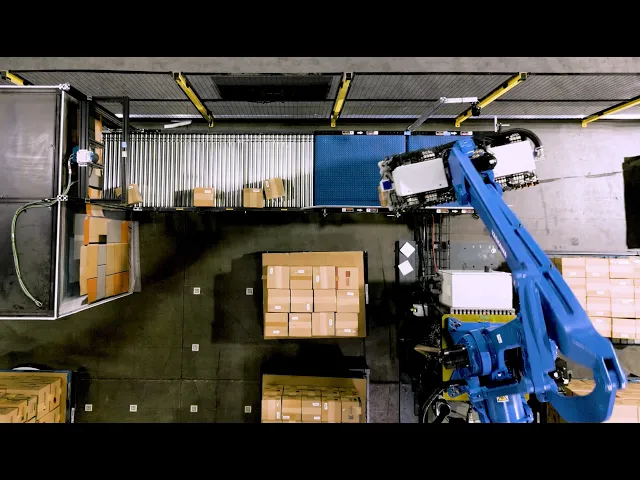
Using a FANUC robotic arm, this application showcases intelligent handling without the complexity of traditional systems. The system processes varying case sizes and load patterns automatically with no teaching for new SKUs. Multi-pick capability grasps multiple cases or cartons simultaneously and places them onto conveyors or outbound lanes in single motions. MujinOS handles the complexity: automatically calculating collision-free paths, ensuring stable placements, and adapting inreal time to the unpredictable nature of mixed loads.
What made all three possible? MujinOS operating as a continuous feedback loop: perceiving the environment in real time, planning collision-free trajectories, executing seamlessly, and adapting instantly when conditions change.
Unifying the Entire Fleet: Fleet Manager and Execution Layer
But intelligent automation doesn't stop at individual robots. Most warehouses struggle coordinating dozens of AMRs and AGVs, each requiring its own proprietary fleet software. Operators bounce between interfaces. Deployment takes months. Scaling becomes a vendor management problem.
Mujin Fleet Manager solves this through unified fleet intelligence: manage your mobile robots within one intelligent platform. New robots start autonomous operations within minutes. The system continuously re-optimizes routes and task assignments on-the-fly as conditions change.
Key capabilities include simple map building with instant updates to pathing, plug-and-play integration, and interleaved planning that dynamically adjusts to new information without stopping operations. Users configure and manage fleets directly through MujinOS, eliminating the fragmentation of OEM-specific fleet tools.
Beyond fleet management, MujinOS provides a complete execution layer coordinating mobile robots, stationary arms, conveyors, and human teams through a single operating system. This extends physical AI beyond individual robots into system-wide intelligence: every asset, every workflow coordinated in real time.
MujinOS isn't just software. It's a complete reimagining of how robots work. The platform operates as physical AI through four interconnected capabilities:
Perception
MujinOS continuously maps the workspace using vision and sensors, keeping a real-time digital model of every asset, object, and condition. It's not just seeing—it's understanding. Automatic SKU registration, real-time item detection, collision awareness. The system knows what it's looking at and where everything is, every moment.
Motion Planning
Instead of pre-taught point-to-point movements, MujinOS calculates real-time, collision-free paths that optimize for speed and reliability. The robot doesn't follow a script. It solves the problem in real time. Every cycle is unique. Every path is calculated for maximum efficiency.
Digital Twin
Complex tasks are designed, tested, and validated in a real-time digital twin before a single move happens on the physical floor. This isn't just visualization—it's the same logic running in parallel with the physical system. When the digital twin succeeds, the physical execution will succeed. Zero surprises. Zero unplanned downtime.
Orchestration
Everything in the system—the robots, conveyors, AGVs, sensors, and safety systems—is coordinated through a single control layer. No vendor silos or proprietary protocols get in the way. One operating system manages the entire system end-to-end. When integrators deploy MujinOS, they're not gluing together five different systems. They're deploying a unified brain that handles it all.
The results? 30% higher throughput. 4x faster deployment. ROI in under two years.
The Subscription Shift: Automation as an Evolving Service
Alongside the booth demonstrations, Mujin announced a strategic shift in how customers access intelligent automation: a subscription service model for MujinOS.
This isn't about changing pricing. It's about changing how automation improves over time.
Traditional robotics required massive upfront capital investment and one-time software licensing. The system you bought on Day 1 is the system you have in Year 5, unless you pay for a complete re-engineering. MujinOS subscriptions work differently: continuous software upgrades, dedicated technical support, real-time monitoring dashboards, and managed deployments handled by Mujin's field engineering team. Zero unplanned downtime during updates.
For end users, this means their robots get smarter automatically. New vision algorithms. Better motion planning. Improved orchestration logic. All delivered as software updates, not hardware replacements.
For integrators, it simplifies everything: faster commissioning, no-code configuration tools that let customers self-serve on minor adjustments, and a revenue model that aligns Mujin's success with long-term customer success.
The subscription launches in Standard and Premium tiers, starting with Single SKU Palletizing, with additional applications rolling out as ready.
The Hardware Breakthrough: MCX2 and MPX2 Make Their Debut
One of the most significant announcements at MODEX was the debut of the MCX2 controller and MPX2 pendant—the next generation of industrial-grade control hardware purpose-built for physical AI at scale. With a product expert on the floor demonstrating both systems in action, attendees witnessed firsthand how these represent a fundamental shift in how intelligent automation is delivered to the factory floor.
The MCX2 is the industrial-grade platform that powers MujinOS at enterprise scale. It provides real-time deterministic control, certified safety compliance (UL 61010, Cat 3 PLd), and multi-protocol connectivity (Ethernet/IP, PROFINET, Modbus) to manage robots, conveyors, and sensors with industrial reliability. Expandable I/O. Real-time OS. This is the hardware foundation that makes physical AI production-ready.
The MPX2 pendant is the operator interface: wireless control with integrated safety systems and real-time validation ensuring precise, secure operation anywhere on the warehouse floor. Move freely. Operate safely. It transforms how humans interact with autonomous systems, not through rigid command-and-control, but through intelligent assistance and real-time feedback.
Together at their MODEX debut, the MCX2 and MPX2 embodied Mujin's core philosophy: drive intelligence, command with confidence. The hardware is built to support physical AI at scale. It's reliable, certified, and ready for the next generation of warehouse automation.
The Full Experience: From Technical Presentations to Student Engagement
The Mujin MODEX booth wasn't just a demo floor. It was an ecosystem in action. Mujin hosted dozens of one-on-one meetings with end users and integrators, giving them hands-on time to explore the digital twin, see the no-code interface, and understand how orchestration actually works in practice.
The booth also hosted live technical presentations four times daily, featuring representatives from Mujin's partner community: FANUC, Kawasaki Robotics, Yaskawa, SICK, Geek+, and Schmalz. Each talk provided technical insight about how each manufacturer's hardware integrates with MujinOS and what that partnership makes possible.
Beyond the industry professionals, Mujin invested in the future. The company hosted several Student Day touring groups, sharing advanced physical AI technology with students of all ages and sparking early passion for intelligent robotics. The booth also welcomed groups from the TRG and RoboGeorgia booth tour, extending Mujin's reach into the broader robotics and automation community.
And yes, there was a happy hour. Because at the end of the day, the strongest partnerships are built on more than technology specs and ROI calculations.
What Physical AI Means for the Industry
The warehouse and logistics industry has been fragmented by vendor silos and rigid automation for decades. Point solutions from different manufacturers. Integrators piecing together systems that barely talk to each other. Operations teams managing multiple control layers. It's expensive. It's brittle. It doesn't scale.
Mujin's MODEX presence made one thing unmistakable: this era is ending.
Physical AI, the combination of advanced perception, autonomous motion planning, and intelligent orchestration, is making truly flexible, adaptive automation possible. It's not automation that follows programs. It's automation that understands its environment, learns from every cycle, and continuously optimizes.
For the thousands of visitors who stopped by the Mujin booth and saw physical AI operating in real production scenarios, the message was clear:
Mujin isn't selling robots. We're advancing robotics with physical AI—intelligence that perceives, plans, executes, and adapts in real time. And it works across any hardware, scales without limits, and improves continuously.
That's the future. And it's here now.
If there was one thing every visitor to the Mujin booth at MODEX 2026 witnessed, it was the tangible reality of physical AI, experiencing robots that perceive their environment, plan their own movements in real time, and execute complex tasks without human intervention or pre-programmed paths.
Four robots. Four different manufacturers. Zero human in the loop. All orchestrated flawlessly by a single intelligent operating system.
For decades, warehouse and logistics operations have been built on integration chaos: rigid systems that don't talk to each other, manufacturers whose products don't play well with competitors, and operations teams stuck maintaining separate control layers for every robot. Each system sees only its own corner of the warehouse. Each movement is pre-taught. Scaling is a monumental challenge.
Mujin came to MODEX 2026 with a different vision: what if robots had intelligence?
From April 13-16 at the Georgia World Congress Center in Atlanta, Mujin showcased how physical AI transforms automation from reactive sequences into intelligent, adaptive systems. The centerpiece: MujinOS, a no-code platform that brings real perception, autonomous motion planning, and dynamic orchestration to any robot or warehouse floor. It's automation that learns, adapts, and optimizes in real time without human intervention or rigid pre-programming.
The message to every integrator, end user, and manufacturer on the floor was clear: this is physical AI in production. And it's changing what's possible.
The Living Proof: Four Robot Systems, One Brain
The centerpiece of the Mujin booth wasn't a flashy marketing display. It was a continuous loop of real work: robots from Kawasaki, FANUC, Yaskawa, and Geek+, each assigned to do different tasks, each built by different companies—orchestrated by MujinOS into a seamless, autonomous workflow. No teaching. No intervention. Just pure intelligence coordinating hardware across competing vendors.
This wasn't a simulation running in a digital twin. This was live. This was production-ready.This was the future, running on the floor right now.
Three mission-critical applications demonstrated what intelligent automation actually delivers:
Inbound Palletizing
Powered by a Yaskawa robotic arm and Schmalz row picking gripper, with inbound barcode scanning handled by a SICK scan tunnel, this solution achieved rates near 1,000 cases per hour through autonomous motion planning. Unlike traditional robots that follow pre-taught sequences, MujinOS calculates optimized stacking patterns on the fly. Flexible, stable stacking that adapts to variations in case size, pallet position, and load conditions allows for the delivery of maximum pallets per hour with minimal system complexity, eliminating manual intervention entirely.
Mixed-SKU Palletizing (Order Fulfillment)
Set up to create store-ready mixed-SKU pallets, this application handles the complexity and volume that breaks traditional automation. The system manages high SKU variability, changing order profiles, and unpredictable inventory—exactly the scenario where rigid pre-programming fails. MujinOS creates rainbow pallets ready for retail and grocery distribution, perfectly suited for 3PL operations where order profiles and customer requirements shift constantly. Multi-pick capability allows the gripper to grasp two or more cases simultaneously and place them in a single motion, automatically calculating collision-free paths and stable placements with no teaching required for new SKUs.
Mixed-SKU Depalletizing
Using a FANUC robotic arm, this application showcases intelligent handling without the complexity of traditional systems. The system processes varying case sizes and load patterns automatically with no teaching for new SKUs. Multi-pick capability grasps multiple cases or cartons simultaneously and places them onto conveyors or outbound lanes in single motions. MujinOS handles the complexity: automatically calculating collision-free paths, ensuring stable placements, and adapting inreal time to the unpredictable nature of mixed loads.
What made all three possible? MujinOS operating as a continuous feedback loop: perceiving the environment in real time, planning collision-free trajectories, executing seamlessly, and adapting instantly when conditions change.
Unifying the Entire Fleet: Fleet Manager and Execution Layer
But intelligent automation doesn't stop at individual robots. Most warehouses struggle coordinating dozens of AMRs and AGVs, each requiring its own proprietary fleet software. Operators bounce between interfaces. Deployment takes months. Scaling becomes a vendor management problem.
Mujin Fleet Manager solves this through unified fleet intelligence: manage your mobile robots within one intelligent platform. New robots start autonomous operations within minutes. The system continuously re-optimizes routes and task assignments on-the-fly as conditions change.
Key capabilities include simple map building with instant updates to pathing, plug-and-play integration, and interleaved planning that dynamically adjusts to new information without stopping operations. Users configure and manage fleets directly through MujinOS, eliminating the fragmentation of OEM-specific fleet tools.
Beyond fleet management, MujinOS provides a complete execution layer coordinating mobile robots, stationary arms, conveyors, and human teams through a single operating system. This extends physical AI beyond individual robots into system-wide intelligence: every asset, every workflow coordinated in real time.
MujinOS isn't just software. It's a complete reimagining of how robots work. The platform operates as physical AI through four interconnected capabilities:
Perception
MujinOS continuously maps the workspace using vision and sensors, keeping a real-time digital model of every asset, object, and condition. It's not just seeing—it's understanding. Automatic SKU registration, real-time item detection, collision awareness. The system knows what it's looking at and where everything is, every moment.
Motion Planning
Instead of pre-taught point-to-point movements, MujinOS calculates real-time, collision-free paths that optimize for speed and reliability. The robot doesn't follow a script. It solves the problem in real time. Every cycle is unique. Every path is calculated for maximum efficiency.
Digital Twin
Complex tasks are designed, tested, and validated in a real-time digital twin before a single move happens on the physical floor. This isn't just visualization—it's the same logic running in parallel with the physical system. When the digital twin succeeds, the physical execution will succeed. Zero surprises. Zero unplanned downtime.
Orchestration
Everything in the system—the robots, conveyors, AGVs, sensors, and safety systems—is coordinated through a single control layer. No vendor silos or proprietary protocols get in the way. One operating system manages the entire system end-to-end. When integrators deploy MujinOS, they're not gluing together five different systems. They're deploying a unified brain that handles it all.
The results? 30% higher throughput. 4x faster deployment. ROI in under two years.
The Subscription Shift: Automation as an Evolving Service
Alongside the booth demonstrations, Mujin announced a strategic shift in how customers access intelligent automation: a subscription service model for MujinOS.
This isn't about changing pricing. It's about changing how automation improves over time.
Traditional robotics required massive upfront capital investment and one-time software licensing. The system you bought on Day 1 is the system you have in Year 5, unless you pay for a complete re-engineering. MujinOS subscriptions work differently: continuous software upgrades, dedicated technical support, real-time monitoring dashboards, and managed deployments handled by Mujin's field engineering team. Zero unplanned downtime during updates.
For end users, this means their robots get smarter automatically. New vision algorithms. Better motion planning. Improved orchestration logic. All delivered as software updates, not hardware replacements.
For integrators, it simplifies everything: faster commissioning, no-code configuration tools that let customers self-serve on minor adjustments, and a revenue model that aligns Mujin's success with long-term customer success.
The subscription launches in Standard and Premium tiers, starting with Single SKU Palletizing, with additional applications rolling out as ready.
The Hardware Breakthrough: MCX2 and MPX2 Make Their Debut
One of the most significant announcements at MODEX was the debut of the MCX2 controller and MPX2 pendant—the next generation of industrial-grade control hardware purpose-built for physical AI at scale. With a product expert on the floor demonstrating both systems in action, attendees witnessed firsthand how these represent a fundamental shift in how intelligent automation is delivered to the factory floor.
The MCX2 is the industrial-grade platform that powers MujinOS at enterprise scale. It provides real-time deterministic control, certified safety compliance (UL 61010, Cat 3 PLd), and multi-protocol connectivity (Ethernet/IP, PROFINET, Modbus) to manage robots, conveyors, and sensors with industrial reliability. Expandable I/O. Real-time OS. This is the hardware foundation that makes physical AI production-ready.
The MPX2 pendant is the operator interface: wireless control with integrated safety systems and real-time validation ensuring precise, secure operation anywhere on the warehouse floor. Move freely. Operate safely. It transforms how humans interact with autonomous systems, not through rigid command-and-control, but through intelligent assistance and real-time feedback.
Together at their MODEX debut, the MCX2 and MPX2 embodied Mujin's core philosophy: drive intelligence, command with confidence. The hardware is built to support physical AI at scale. It's reliable, certified, and ready for the next generation of warehouse automation.
The Full Experience: From Technical Presentations to Student Engagement
The Mujin MODEX booth wasn't just a demo floor. It was an ecosystem in action. Mujin hosted dozens of one-on-one meetings with end users and integrators, giving them hands-on time to explore the digital twin, see the no-code interface, and understand how orchestration actually works in practice.
The booth also hosted live technical presentations four times daily, featuring representatives from Mujin's partner community: FANUC, Kawasaki Robotics, Yaskawa, SICK, Geek+, and Schmalz. Each talk provided technical insight about how each manufacturer's hardware integrates with MujinOS and what that partnership makes possible.
Beyond the industry professionals, Mujin invested in the future. The company hosted several Student Day touring groups, sharing advanced physical AI technology with students of all ages and sparking early passion for intelligent robotics. The booth also welcomed groups from the TRG and RoboGeorgia booth tour, extending Mujin's reach into the broader robotics and automation community.
And yes, there was a happy hour. Because at the end of the day, the strongest partnerships are built on more than technology specs and ROI calculations.
What Physical AI Means for the Industry
The warehouse and logistics industry has been fragmented by vendor silos and rigid automation for decades. Point solutions from different manufacturers. Integrators piecing together systems that barely talk to each other. Operations teams managing multiple control layers. It's expensive. It's brittle. It doesn't scale.
Mujin's MODEX presence made one thing unmistakable: this era is ending.
Physical AI, the combination of advanced perception, autonomous motion planning, and intelligent orchestration, is making truly flexible, adaptive automation possible. It's not automation that follows programs. It's automation that understands its environment, learns from every cycle, and continuously optimizes.
For the thousands of visitors who stopped by the Mujin booth and saw physical AI operating in real production scenarios, the message was clear:
Mujin isn't selling robots. We're advancing robotics with physical AI—intelligence that perceives, plans, executes, and adapts in real time. And it works across any hardware, scales without limits, and improves continuously.
That's the future. And it's here now.
Hubspot
Set a portal ID and form in the Properties.
Have a question?
Learn how MujinOS delivers real-time perception, motion control, and no-code deployment—across any robotic system
Have a question?
Learn how MujinOS delivers real-time perception, motion control, and no-code deployment—across any robotic system