

Technology
Learn about the platform powering today's most advanced automation applications
Learn more about MujinOS
Learn about the platform powering today's most advanced automation applications
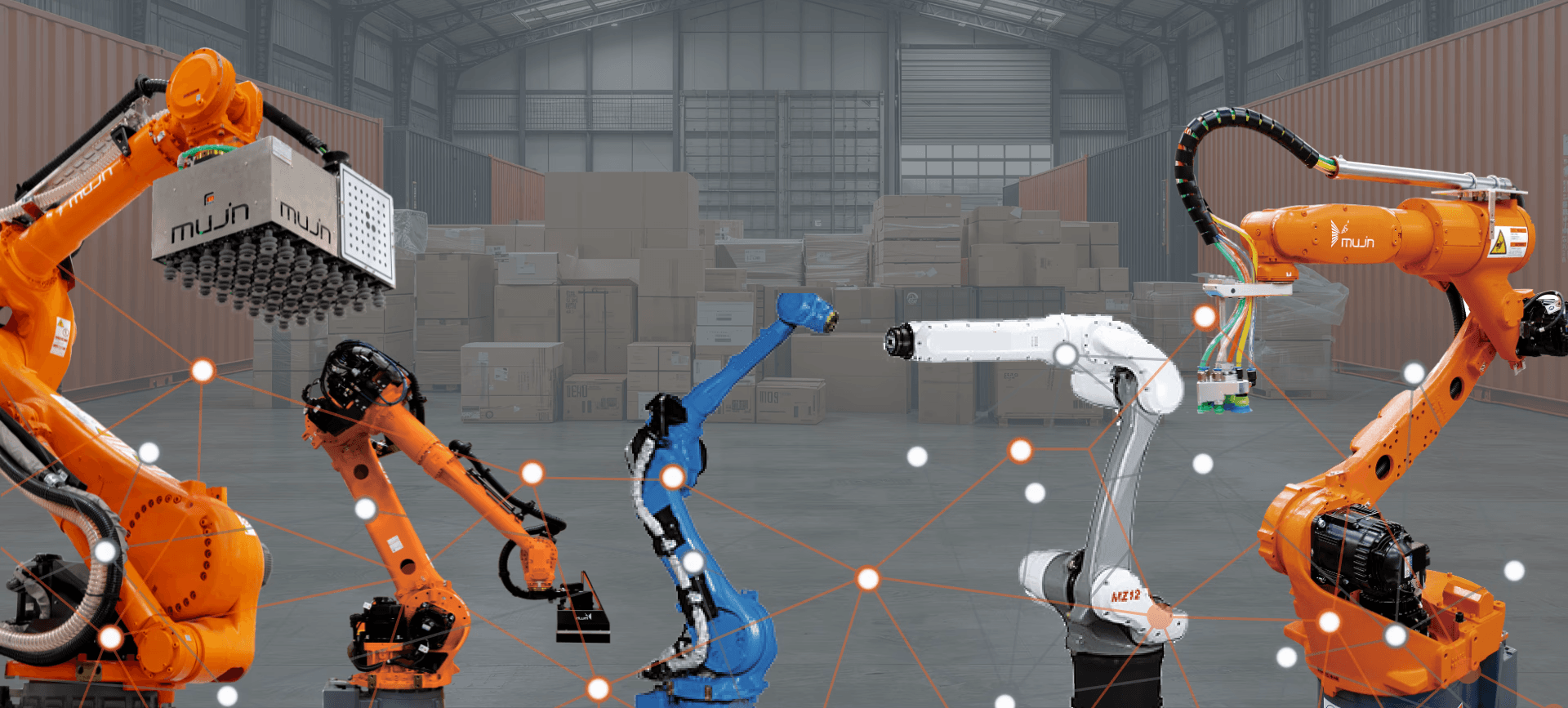
The Rise of Physical AI: Why Robotics Is Entering Its Most Transformative Decade Yet
The Rise of Physical AI: Why Robotics Is Entering Its Most Transformative Decade Yet
For decades, robotics has promised efficiency, scale and consistency. And while industrial robots have undeniably transformed manufacturing and logistics, most automation systems today are still constrained by a fundamental limitation: they can only do what they have been explicitly programmed to do.
That’s changing fast.
We are now entering the era of Physical AI, where robots do not just execute instructions but perceive, reason and adapt in real time. This shift is redefining what automation can achieve and setting the stage for the most transformative decade robotics has ever seen.
From Rigid Automation to Intelligent Systems
Traditional industrial robotics was built for predictability. Fixed SKUs. Fixed layouts. Fixed processes. Engineers spent months designing systems that worked beautifully until something changed.
And something always changes.
New products, new packaging, new suppliers, new order profiles, seasonal spikes, labor shortages and space constraints constantly disrupt operations. In these environments, conventional automation struggles. Every change triggers reprogramming, downtime or costly re-engineering.
Physical AI represents a fundamental break from this model.
Instead of hard-coded logic, Physical AI systems:
Perceive the real world through advanced vision and sensing
Understand spatial relationships between objects, machines and environments
Make decisions dynamically based on real-time conditions
Continuously optimize performance without manual intervention
In short, these systems behave less like machines and more like adaptive operators.
Why Physical AI Is Emerging Now
The rise of Physical AI isn’t theoretical. It’s the result of several forces converging at once:
Exploding Operational Complexity
Warehouses and factories are handling more SKUs, more variation and more volatility than ever before. E-commerce, omni-channel fulfillment and mass customization have shattered the assumptions automation was built on.
Chronic Labor Shortages
Manual work remains the backbone of many operations, but labor availability continues to decline, especially for physically demanding, repetitive tasks. Automation is no longer a “nice to have”; it’s a necessity.
Advances in Compute, Vision and AI
Modern AI can now process massive volumes of spatial and operational data in real time. What once required human intuition can increasingly be handled by software.
The Shift from Hardware Centric to Software Defined Automation
The most important breakthroughs in robotics are no longer mechanical, they are digital. Intelligence is moving into software platforms that can orchestrate entire operations, not just individual machines.
What Makes Physical AI Different
Not all “AI-powered robotics” is Physical AI.
Many systems still rely on:
Pre-defined rules
Static motion paths
Offline simulation disconnected from live operations
Physical AI systems are fundamentally different because they operate on live digital representations of the physical world.
At the core is a real-time digital twin that mirrors the environment as it exists now, not as it was designed months ago. Every robot, conveyor, pallet, case and constraint is continuously updated in software.
This allows the system to:
Recalculate motion paths on the fly
Adjust sequencing based on upstream and downstream conditions
Handle unknown objects and variation without stopping
Optimize throughput, space utilization and stability simultaneously
The result is automation that scales with complexity instead of breaking under it.
From Robot Control to System Orchestration
One of the biggest shifts enabled by Physical AI is the move from robot level control to system level intelligence.
Historically, each robot was programmed as an isolated unit. Integrating multiple robots or mixing vendors added exponential complexity. Engineers became the bottleneck.
Physical AI platforms flip this model.
Instead of managing individual machines, they:
Centralize intelligence in software
Coordinate robots, conveyors, AMRs and sensors as one system
Balance workloads dynamically across the operation
Enable rapid reconfiguration without rewriting logic
This is where platforms like Mujin have played a pivotal role. By embedding Physical AI into MujinOS, intelligence moves above the hardware layer allowing automation to adapt as a living system rather than a fixed installation.
The Business Impact: Why This Decade Is Different
Physical AI isn’t just a technical evolution, it’s a business inflection point.
Organizations adopting these systems are seeing:
Faster deployment without extensive programming
Higher throughput in high SKU, mixed load environments
Reduced downtime during changeovers or demand spikes
Better space utilization through dense, stable packing and dynamic routing
Lower total cost of ownership driven by software driven scalability
Perhaps most importantly, Physical AI future proofs automation investments. Instead of ripping and replacing systems every time operations change, companies can evolve continuously through software.
Where Physical AI Is Already Winning
Physical AI is already proving its value in some of the most complex environments:
Mixed SKU palletizing and depalletizing
High variation case picking
Inbound receiving and pallet build optimization
Manufacturing lines with frequent product changeovers
Facilities running multi-vendor robotic fleets
These are exactly the areas where traditional automation struggled most and where human labor has remained dominant.
That’s no coincidence.
Looking Ahead: The Next 10 Years of Robotics
Over the next decade, the robotics leaders will not be defined by who builds the fastest robot or the strongest arm. They’ll be defined by who owns the intelligence layer.
Physical AI will become the foundation for:
Fully adaptive warehouses
Self optimizing factories
Rapidly deployable automation across global sites
Software defined operations that improve over time
We are moving from automation as an asset to automation as a living system - one that learns, adapts and scales with the business.
Final Thought
Robotics isn’t entering a slow evolution. It’s entering a decisive transformation.
Physical AI marks the moment when automation stops being rigid and starts becoming resilient. When robots stop waiting for instructions and start responding to reality. And when software, not hardware becomes the true engine of operational advantage.
The next decade of robotics will not just be automated.
It will be intelligent.
For decades, robotics has promised efficiency, scale and consistency. And while industrial robots have undeniably transformed manufacturing and logistics, most automation systems today are still constrained by a fundamental limitation: they can only do what they have been explicitly programmed to do.
That’s changing fast.
We are now entering the era of Physical AI, where robots do not just execute instructions but perceive, reason and adapt in real time. This shift is redefining what automation can achieve and setting the stage for the most transformative decade robotics has ever seen.
From Rigid Automation to Intelligent Systems
Traditional industrial robotics was built for predictability. Fixed SKUs. Fixed layouts. Fixed processes. Engineers spent months designing systems that worked beautifully until something changed.
And something always changes.
New products, new packaging, new suppliers, new order profiles, seasonal spikes, labor shortages and space constraints constantly disrupt operations. In these environments, conventional automation struggles. Every change triggers reprogramming, downtime or costly re-engineering.
Physical AI represents a fundamental break from this model.
Instead of hard-coded logic, Physical AI systems:
Perceive the real world through advanced vision and sensing
Understand spatial relationships between objects, machines and environments
Make decisions dynamically based on real-time conditions
Continuously optimize performance without manual intervention
In short, these systems behave less like machines and more like adaptive operators.
Why Physical AI Is Emerging Now
The rise of Physical AI isn’t theoretical. It’s the result of several forces converging at once:
Exploding Operational Complexity
Warehouses and factories are handling more SKUs, more variation and more volatility than ever before. E-commerce, omni-channel fulfillment and mass customization have shattered the assumptions automation was built on.
Chronic Labor Shortages
Manual work remains the backbone of many operations, but labor availability continues to decline, especially for physically demanding, repetitive tasks. Automation is no longer a “nice to have”; it’s a necessity.
Advances in Compute, Vision and AI
Modern AI can now process massive volumes of spatial and operational data in real time. What once required human intuition can increasingly be handled by software.
The Shift from Hardware Centric to Software Defined Automation
The most important breakthroughs in robotics are no longer mechanical, they are digital. Intelligence is moving into software platforms that can orchestrate entire operations, not just individual machines.
What Makes Physical AI Different
Not all “AI-powered robotics” is Physical AI.
Many systems still rely on:
Pre-defined rules
Static motion paths
Offline simulation disconnected from live operations
Physical AI systems are fundamentally different because they operate on live digital representations of the physical world.
At the core is a real-time digital twin that mirrors the environment as it exists now, not as it was designed months ago. Every robot, conveyor, pallet, case and constraint is continuously updated in software.
This allows the system to:
Recalculate motion paths on the fly
Adjust sequencing based on upstream and downstream conditions
Handle unknown objects and variation without stopping
Optimize throughput, space utilization and stability simultaneously
The result is automation that scales with complexity instead of breaking under it.
From Robot Control to System Orchestration
One of the biggest shifts enabled by Physical AI is the move from robot level control to system level intelligence.
Historically, each robot was programmed as an isolated unit. Integrating multiple robots or mixing vendors added exponential complexity. Engineers became the bottleneck.
Physical AI platforms flip this model.
Instead of managing individual machines, they:
Centralize intelligence in software
Coordinate robots, conveyors, AMRs and sensors as one system
Balance workloads dynamically across the operation
Enable rapid reconfiguration without rewriting logic
This is where platforms like Mujin have played a pivotal role. By embedding Physical AI into MujinOS, intelligence moves above the hardware layer allowing automation to adapt as a living system rather than a fixed installation.
The Business Impact: Why This Decade Is Different
Physical AI isn’t just a technical evolution, it’s a business inflection point.
Organizations adopting these systems are seeing:
Faster deployment without extensive programming
Higher throughput in high SKU, mixed load environments
Reduced downtime during changeovers or demand spikes
Better space utilization through dense, stable packing and dynamic routing
Lower total cost of ownership driven by software driven scalability
Perhaps most importantly, Physical AI future proofs automation investments. Instead of ripping and replacing systems every time operations change, companies can evolve continuously through software.
Where Physical AI Is Already Winning
Physical AI is already proving its value in some of the most complex environments:
Mixed SKU palletizing and depalletizing
High variation case picking
Inbound receiving and pallet build optimization
Manufacturing lines with frequent product changeovers
Facilities running multi-vendor robotic fleets
These are exactly the areas where traditional automation struggled most and where human labor has remained dominant.
That’s no coincidence.
Looking Ahead: The Next 10 Years of Robotics
Over the next decade, the robotics leaders will not be defined by who builds the fastest robot or the strongest arm. They’ll be defined by who owns the intelligence layer.
Physical AI will become the foundation for:
Fully adaptive warehouses
Self optimizing factories
Rapidly deployable automation across global sites
Software defined operations that improve over time
We are moving from automation as an asset to automation as a living system - one that learns, adapts and scales with the business.
Final Thought
Robotics isn’t entering a slow evolution. It’s entering a decisive transformation.
Physical AI marks the moment when automation stops being rigid and starts becoming resilient. When robots stop waiting for instructions and start responding to reality. And when software, not hardware becomes the true engine of operational advantage.
The next decade of robotics will not just be automated.
It will be intelligent.
Hubspot
Set a portal ID and form in the Properties.
Have a question?
Learn how MujinOS delivers real-time perception, motion control, and no-code deployment—across any robotic system
Have a question?
Learn how MujinOS delivers real-time perception, motion control, and no-code deployment—across any robotic system